
Aiden Vuong
Where Ends Meet
A game's project Portfolio and Blog

Proposal
01
Target Audience
Proposal
The target audience for my game would be people from age 13 and over, who are interested in open-world RPG games with an interesting story to keep the player hooked. This can involve games like Nintendo's Zelda: Breath of the Wild. Where the user can freely explore the world.
02
Executive Summary
Proposal
The story of the game is where someone wakes up from a nap and realises one of their friends has gone missing. They teamed up with their friends to try find hints and clues to find their friend. They defeat enemies and obstacles along the way. They find the missing access key and find their way through the city. When they reach close to the end, there is a boss fight and when they complete the boss fight, they save their friend.
03
Outline
Proposal
We will need to access the Adobe suite including Photoshop and Premiere Pro/After Effects to design and animate the game. We need to use Blender to animate, and 3D model. We will be using Unreal Engine will be the game engine to script and piece everything together. We will be using Garage Band for sound design. The reason we chose these programs is because we already have significant experience with them. Learning a new software would be difficult and time consuming. As well as we can easily access them from any computer. I chose Unreal Engine because their blueprint system allows easy experimentation without long hours of coding.
04
Unique Selling Point
Proposal
The unique selling point for my project varies from different aspects of the project. First off all, the art style will be a mix of real-life graphics with animated cartoon characters and decorative pieces like trees, rocks and vines. Another selling point of the project is the story and the progression along the way. Unlike traditional open-world games that rely on combat, this project primarily focuses on puzzles, which will advance the users tactical thinking and decisions. The game would have unique voice lines and an interesting story to engage the user.
05
Inspirations and competitive products
Proposal
The inspiration for this project involves the stories of Mario games from Nintendo. Including the rescue of Peach from Bowser. Another inspiration is the open world of Zelda games, letting the user roam freely around the map.
06
Main Proposal
Proposal
Concept - 3D Open-World Post-Human RPG
Target Market - The game would target people who are 13+, anyone that plays role-playing, story-based games and exploration/adventure games; any player who enjoys games like the Legend of Zelda and the Mario series. This concept of the game is directed at gamers that prefer playing games that contain an underlying story, are free to roam an open world that is set in the distant future and that contain puzzle-solving, as well as skill progression.
Executive Summary - An open world, third-person, 3D, post-human earth role-playing game; the population has become quite sparse with only handful of surviving humans that remain. Nature has begun to reclaim cities which are slowly being overgrown with plant life while leaving human settlements to fall to ruins of technology and deadly conditions. Players are able to guide the protagonist, starting out in their own hometown which is now overgrown, through various hostile environments. Players will be expected to collect upgrades, skills and powerups; they will also be expected to complete tasks, destroy various opponents that lurk in the open world and save a friend of the protagonist, that has been abducted by a nemesis and it also needs to be discovered why civilization has declined so rapidly. The idea is that players will discover what their character and the world itself has gone through via an adventure story that has a large element of exploring the environment with new age hardware.
Software - Unreal Engine 5 and Visual Studio to program the game logic, scripting and to handle all implementations. All 3D modeling, design and animated assets to be created using Blender with all concept and texture work to be designed using Photoshop, finally all sound effects and audio to be generated using Garage Band.
Team Roles - As this is a small team, every member will have to contribute to more than one of the different disciplines to achieve the final result of the game. Initially tasks will consist of brainstorming concepts and visual design using Photoshop with every member contributing to the initial thoughts, to the concept art creation with more emphasis being placed on the members that have a stronger artistic flair. Subsequently 3D modelling will take place with each model being created and animated within Blender. Once modelling is finished, all the models are integrated into the game within the Unreal Engine and Visual Studio in order to program the complex game play systems and scripting. Finally the sounds effects are incorporated in using Garage Band and the game is then ready for any necessary testing and refinements. All members of the team must contribute towards linking all aspects of the game development process together, in order to create a coherent playable experience.
Why I Chose This Concept - I have chosen this concept as I believe it will allow each member of the team to implement and utilize all of their acquired skills, not just programming or design related, but even 3D animation, modelling and art creation, sound design, etc. It allows the team to explore new opportunities for exploration and story building with a great amount of freedom for creative interpretation. The concept itself is interesting as the fusion of the modern city with nature, or the modern city overtaken by nature, will look spectacular on screen and will appeal to players.
This game concept is going to demand programmers and designers within all of the fields already specified such as, artwork, 3D modelling, scripting, animation and sound. The artwork will first be produced with Photoshop by creating original concept artwork along with referencing various artworks. Blender will then be used to produce all of the models along with animating the world environment as well as the character. The game itself and all of the game play systems required will then be constructed using the Unreal Engine and Visual Studio which can both be programmed to accept a script. The final audio aspect, namely the sounds effects, will all be produced and mixed using Garage Band.
Aside from the software listed above, a large amount of research will need to be done; research into the games market as well as player interests and requirements. Primary research will take place in order to gauge the target market's desires, opinions, and suggestions as well as to obtain feedback about the game so that the project can be tailored towards the audience. Secondary research will involve looking for and gathering available information regarding game development and design, as well as rival games so that current market trends can be established and utilized. Market research will also be a significant task involving analysing potential sales platform, appropriate pricing and identifying the target market.
The themes that the game will focus upon are technological progression and advancement within a post-human world. The Earth's environment will have degraded into near zero-population status, nature having consumed most of the former man-made world. The target market will be users that prefer story-driven games and Role-Playing-Games, whereas the rival games are likely to be the Mario and Legend of Zelda series.
The main objective for the player within the narrative is to find and save the protagonist's friend from a villainous antagonist. Throughout this adventure, the player must learn to navigate new environments and their inherent challenges, progress in skills and upgrades and establish why the known world has crumbled into the state it has. The intended platform for this game is PC although there is a possible venture to produce a version that can be used on play station. The game play itself will consist of being placed into an open-world setting that has been taken over by plants with the city serving as a starting point; from here the protagonist must rescue his/her friend whilst finding out the origins of the world's decline.
Other Proposals
01
02
Other Proposals
Alternative concept - 2D Side-Scrolling Rescue Adventure
Target Market - Ages 10+. Players interested in platformers and puzzle games. E.g. Ori and the Blind Forest or Hollow Knight. A younger/wider market then the 3D concept because the control scheme is simplified and the visuals are not so complex.
Executive summary - The same story; the four friends, one goes missing, the others try to get them back, in a 2D side scrolling platformer environment. Players would move left-right through a series of dilapidated, over grown urban environments, navigating and solving simple puzzles, and defeating or avoiding robot enemies. This would be 2D hand painted sprites, made in Photoshop, and this would mean the artwork of Kat would have a much bigger impact.
Software - Unreal Engine (Paper2D Plugin), Adobe Photoshop (for sprite creation), Garage Band (for Audio).
Why I rejected this concept - This concept would mean Kat would have to do most of the production work, because of the required work for each 2D sprite compared to 3D animation rigs that can be reused multiple times. With only one main artist working, this would have caused a massive bottleneck. Additionally both me and Alex are much stronger with 3D modelling and the Unreal 3D pipeline than animation in 2D. This concept would also not give me the opportunity to work with the software that I already have skills in.
Other Proposals
Alternative Concept - 3D Open-World Fantasy RPG
Target Market - 13+, Players interested in action RPGs, exploration, character development, and fantasy stories. Audiences to such games as: Elden Ring, the legend of Zelda Tears of the Kingdom and dragon dogma 2. The idea targets players interested in interactive worlds, battle system, and story driven play.
Executive summary - A 3D open world fantasy action RPG set in the world of Elyndor. Elyndor's world used to have a balance maintained by six crystals. All six of them were shattered into shards during the catastrophe known as the Eclipse Fall. Players must control a young guardian named Kael to retrieve the shards to fight against corrupted monsters to restore the balance of the world before its covered by an everlasting darkness. The world includes various terrains such as forests, deserts, mountains and abandoned kingdoms; players will complete quests, upgrading items, unlock abilities, and engage in various activities. The world uses real-time battles, has a variety of boss battles, has character development and equipment improvements, features crafting systems and multiple endings depending on the player's choices.
Software - Unreal Engine 5(game development and programming), Blender(3D modelling, rigging, animation and creation of all assets), Adobe Photoshop or Procreate(concept art and textures), Audacity or GarageBand(audio editing).
Team Roles - I will develop the game using unreal engine 5 implementing game play mechanics, combat mechanics, enemy AI, questing, and integrating all of the assets into the game to create a playability experience. Alex will create the 3D assets using Blender: this will be all characters, weapons, armor, environmental props, creatures, and all of the animations that the game needs. Kat will be creating all of the concept art for each asset: character designs, enemies, locations, equipment, and basically the entire design for how each aspect of the game is supposed to look.
Reason I rejected this concept - This concept calls for a lot of 3D models that will most likely create stress and work overload on Alex. A fair work balance seems like a good idea to prevent this and to increase the work efficiency.
Analysis
01
Analysis
The project requires technical software and creative skills to do with art, 3D modelling, scripting, animating and sound design. We would use Photoshop to create our concept design, we would use Blender to animate, and 3D model, we would use Unreal Engine and Visual Studio to piece everything together and script, we would use Garage Band to create sounds for our game. We would also need different types of research. Which includes primary research, secondary research, and marketplace research. Primary research would be done by generating and making surveys for people to complete. Secondary research would be done by searching for online resources like Wikipedia, and other websites. Marketplace research is done by looking at our competition, while looking at platforms and costs. The theme of our game is Nex generation, which links towards a futuristic style game. We are pushing for a post-human game. Where most of the population has been wiped and Earth looks overgrown and abandoned. Our potential audiences would be people who are intrigued in RPG story games. Our competition would be games like Zelda and Mario. The story and plot are the player is trying to save their friend from someone evil, however they are blocked by obstacles on the way. We would prioritise the PC marketplace but also include Playstation as well. Our base idea is for the player to spawn in an overgrown city, and their objective is to try save their friend from an evil person.
The relatively short theme of "next generation" was easily open to several different interpretations. I read this to be post-human - a version of the world where this generation of humanity has been superseded and replaced or degraded, where the next generation inherits the world, which has already gone ahead without them. This reading afforded the game a narrative, in the protagonist the one caught between being part of this generation, but needing to regain what was lost (the lost friend), and being presented with a strange and overgrown world. The post-human reading also provided clear direction for the art design, as there is one quintessential visual paradigm for this topic in games: NieR: Automata, and the idea of taking this as a primary reference meant the team shared a similar language with which to work. The other reading I explored for the theme of "next generation" was that of futuristic technology, high-rise buildings and neon, advanced UI, and sci-fi architecture. The reason I abandoned this was that these assets would have needed to be modeled and textured with a clean, high-tech and precise finish, which is dramatically more difficult, from a technical perspective, than modeled organic, overgrown objects; deterioration and growth can more easily pass off as being made with students' skill levels.
Research
01
Primary Research
Research
Looking at Chart 1, it shows that RPG and Action-Adventure both received four votes, tying for most popular and 29%. FPS received three votes, very nearly the same as the top two, and with this three-way split I realized that the sample for this survey had broad preferences, rather than one single dominant preference; something that, actually, worked against a single genre and in favour of a hybrid. The specific reason I decided to blend RPG and Action-Adventure, specifically, was that while RPG mechanics provide narrative and character progression RPG systems while Action-Adventure provides the "run around exploring" loop players like. While FPS received a lot of votes, it was not implemented due to the limitations of having a first-person shooter framework that would clash fundamentally with the narrative structure of my game's rescue mission, and my team did not have the experience to build a shooter camera and weapons system in UE in under 10 weeks, and this would eat the entire development period. The lowest vote count in Strategy and Simulation confirm that these two were correctly eliminated.
Chart 2 shows PC as the most voted platform with 5 votes; next come PlayStation and Mobile with 3 each, Xbox with 2, and Nintendo with one. The sheer number of PC votes confirmed the choice of Unreal Engine for this game. The global illumination of UE 5's Lumen and virtualised geometry with Nanite are based on very demanding high-end PC hardware, and will need to be scale way back to work on a Nintendo system or mobile device; my team specifically chose not to develop on mobile, despite three votes, because I chose a 3 rd person camera, a system of high complexity 3D foliage, and dynamic lighting, all things that would require massive re-engineering to work on a restricted mobile budget, since controls would need a new scheme, a different rendering engine pipeline would be required, and asset resolution would have to scale way back: it is effectively a second product that my team wouldn't have time for. With three votes PlayStation was second to PC, and with native UE export support for the PlayStation, it would be the natural second platform to develop on if this project was commercialized; for the purposes of this project, however, only PC development was viable given the 10-week constraint.
Chart 3 is the most difficult chart to analyse as it takes the data in a direction I did not fully follow. Realism gained 5 votes; the highest single response count in any category survey. Yet my game employs a hybrid aesthetic, not full photorealism. This was because fully photorealistic models would require an extremely high poly count, PBR texture maps with separate albedo, normal, roughness, and metallic maps, hair and skin shaders and a skeletal rigging system that meet industry standards. A single photorealistic, game-ready character model built by a professional would take my 3d modeller the entire 10-week period and there would be no time for environmental assets, foliage orprops. Using a low-poly stylised model was a constraint; however, Animated Cartoon and Low-Poly both receiving 3 votes reassured me that there was already a large audience available for this project if my character model was to be stylised. 3D received 4 votes, this reinforced my choice of three dimensions to the game world, completely eliminating the 2 D alternative, and it means that if a larger budget and more time was allocated to this project photorealistic character models would be a viable route.
These three charts confirmed, with one exception, that I understood my target audience well enough: players who are, generally speaking, PC users who want 3D Action-Adventure or RPG games with a realistic visual style for the world. My game followed the platform, the engine, the style, the combination of gameplay genres; the characters were the one area in which I did not deliver the data's recommendation, yet doing so would be unrealistic, production-wise. In evaluating the finished project this will be the only weakness that can be identified; it is not a consequence of the project, but rather an inherent weakness brought about by the constraints of time, that could be resolved with a subsequent build.


02
Secondary Research
Research
NieR: Automata's color palette is extremely desaturated, the whole world feels washed out white, rusted brown, and grey concrete. This choice was made solely to convey an emotion the desaturation of the world acts as proof of death and as a representation of the forgotten world to the player. For my game, I chose to forego this methodology. My game is targeting an audience 13 and older; much younger than the primary NieR audience. A completely desaturated world would likely feel oppressive to this audience and would not be an accessible environment to play in. I took NieR's environmental structural language; abandoned buildings, overgrown fields, empty rooms, etc but I applied Zelda: Breath of the Wild's warm and vibrant color palette. This will communicate the feeling of nature reclaiming the world rather than being destroyed by it, a more hopeful reading of the post-human world.
The machine lifeforms of NieR are deliberately simple, constructed from circles, squares, and cylinders into vaguely humanoid shapes. This immediately makes them uncanny and industrial rather than organically terrifying. The shapes and constructions immediately tell the player that these are constructed objects rather than living things, which directly supports NieR's post-human theme. I modeled my robot enemy in a similar fashion: a basic geometrical construction with cylindrical legs and a spherical head. Alex was handling all character work and all foliage at the time so my job of modeling the robot character was left open ended. Since I lacked a UV map I had to use vertex based face assignment for materials resulting in flat planes of colour rather than a surface detail that suggests that the object is a manufactured tool. The next version of the robot will be properly UV mapped with a metallic material with dents and scratches.
NieR has a very minimal HUD; the health and energy meters appear when you are taking damage and then disappear, the minimap only shows when the pause menu is open, and generally most of the information in NieR is shown through the world itself. This design is directly intended to enhance the immersion in a game that already leans heavily into mood. My game shipped with a completely absent HUD; however, the difference between NieR's minimal HUD and my absent HUD is significant. NieR's HUD is a planned feature, my absence of a HUD is a result of running out of time. Players of NieR always know where they are or where they need to go, and always know how much health they have at a glance. In my game neither of those pieces of information is available. For future projects the absence of a HUD will be something that will be planned as a minimum deliverable from the very beginning.
Zelda: Breath of the Wild fundamentally uses the principle that no place of interest should be invisible from some other vantage point to create a chain reaction of optical curiosity pulling the player in no prescribed direction. The game features almost no conventional quest markers; instead the player sees a tower in the distance, ventures toward it and discovers places organically. This is the design philosophy not the art style. My level design tried to accommodate this principle but the adoption of a neutral FAB marketplace forest terrain proved to undermine it. The FAB map is intended to be a neutral forest environment rather than a space built around sightlines between points of interest. The buildings and foliage assets I placed on the terrain are not strategically placed to pull the player anywhere. If a player spawned in my game they would have no visual stimuli pulling them forward. In an updated version I would place the main buildings atop elevated terrain and raise it from spawn to draw the player with that same optical lure Zelda uses.
It's worth noting that my initial research description of Zelda targeting 'children enjoying freedom and exploration' was a simplification. Breath of the Wild is PEGI 12 and has a wider audience of all ages: it is certainly not the case that its philosophical themes of memory, identity, and sacrifice are intended for the target age group of children. My game is intended for an audience of 13 and older, so its target audience is much closer to Zelda's real audience than I described it as. However Zelda's scope of hundreds of hundreds of thousands of interactive objects, it's massive, seamless open world and physics engine would have required the work of hundreds of developers working over four years, to produce and can't be achieved on the scale that my project demands. My take away from Zelda in this sense is to find one of it's key features and to apply it at my level of production. It's the use of the environment and its visual design as the source of storytelling over text, rather than text and cutscenes, that can be directly applied.


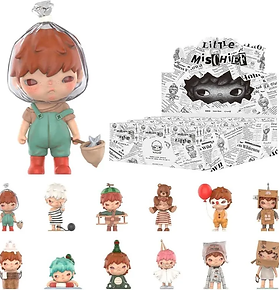
My game's primary reference for character design was the Hinoro series of characters by Lang. Hinoro characters possess the following qualities; their head to body ratio is 1:3 and the heads appear slightly too large, giving them a cartoonish, non threatening quality. Their limbs are tubular, with round ends rather than anatomically correct, to simplify the silhouette and ensure that it will be easily visible on a small screen. Their clothes consist of blocks of flat colour, requiring no shading whatsoever and is perfect for low poly games where we can exploit this and use flat colour textures rather than having to worry about UV maps and gradients. Their faces have only two dots for eyes, a curve for the mouth, but no nose-this allowed a large degree of expressiveness in a minimalist form. I instructed Kat in a document, that the characters in my game should adhere to these qualities (specifically the relative head size and the proportions of limbs) but Kat added much more clothing detail than the original reference; this was Kat's own input and gave the characters much more individuality. This was good as the narrative I had in mind was a rescue one and I wanted the player to feel they were saving specific individuals. The reference I gathered for the environment through Pinterest was of urban decay; abandoned shopping centres, abandoned factories, and city streets over grown with plants. The visual quality consistent throughout all of these images was the contrast between hard geometric forms such as building facades, windows and pavement and the soft, organic forms of plant life such as vines and moss forcing its way through the man made surfaces. This contrast is what I wanted to capture for the games environments. This was achieved through the placing of objects such as building facades and the organic foliage system; the only factor that detracted from this was the organic rolling hills of the FAB base terrain which did not present a clear, hard architectural form to play with.
For marketplaces, I have seen most players on PC, which indicates easier advertisements for PC players. Steam and Epic-Games are one of the most popular options for platforms. Nier Automata has a daily peak of one thousand players, with an all time peak of twenty four thousand players. With The Legend of Zelda: Breath of the Wild, over thirty million copies sold world wide on the Nintendo Switch. Except for PC, people do prefer PlayStation, releasing the game on PlayStation would also increase player base, as some gamers don't have computers at home.


03
Mind Map
Research
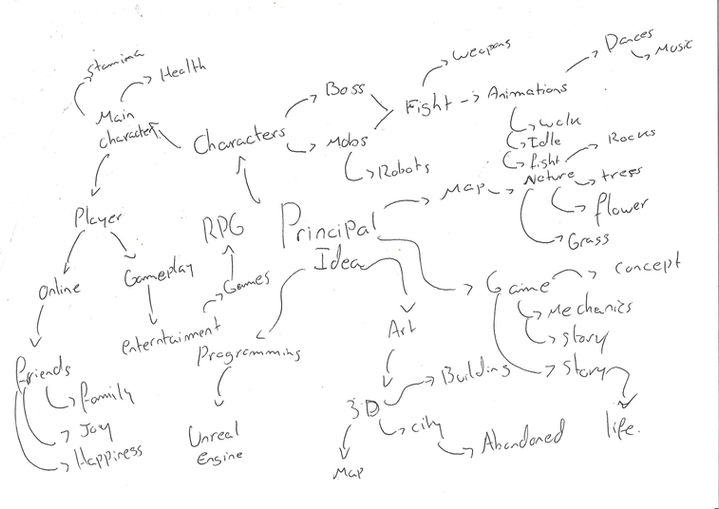
My mind map explains the brief summary on what will be in my game. This explains the principal ideas on what will be in my game and how it will work.